- Home
- Blogs
- About
- Services
- Group Companies
- Contact Us
- सुचना *

-
Call Us On:
+977 1 5320150, 5320160 -
Send us a Mail:
info@cargonepal.com.np -
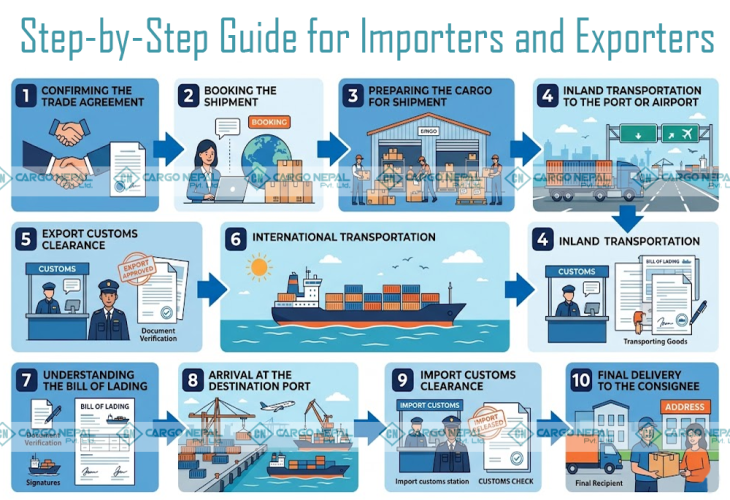
How International Shipping Works: Step-by-Step Guide for Importers and Exporters
International trade has transformed the way businesses operate. Today, a company can manufacture products in one country, source materials from another, and sell to customers across multiple continents. Behind this global movement of goods lies a complex but highly organized system known as international shipping.
For businesses entering global markets for the first time, international shipping can seem overwhelming. Terms like customs clearance, freight forwarding, bills of lading, cargo insurance, and Incoterms often create confusion. However, once you understand the process step by step, international shipping becomes much easier to manage.
Whether you are an importer bringing products into your country or an exporter selling goods overseas, understanding how international shipping works can help you avoid costly mistakes, reduce delays, and improve supply chain efficiency.
In this guide, we will walk through the complete international shipping process, explaining each stage from the moment an order is placed until the cargo reaches its final destination.
Why Understanding International Shipping Matters
Many businesses focus on purchasing and selling products but overlook the logistics involved in moving goods internationally. Yet transportation plays a critical role in determining delivery times, customer satisfaction, and overall profitability.
A shipment that is not properly planned can face customs delays, unexpected charges, documentation issues, or even cargo damage. Understanding the shipping process helps businesses make informed decisions and maintain better control over their operations.
It also enables importers and exporters to communicate more effectively with freight forwarders, shipping lines, customs agents, and logistics providers.
Step 1: Confirming the Trade Agreement
Every international shipment begins with a transaction between a buyer and a seller.
Before any cargo is moved, both parties must agree on several important details, including:
At this stage, one of the most important elements is determining the shipping terms under Incoterms.
What Are Incoterms?
Incoterms, short for International Commercial Terms, are globally recognized trade rules that define the responsibilities of buyers and sellers during transportation.
They clarify who is responsible for:
For example, under FOB (Free on Board), the seller is responsible for delivering goods to the departure port and loading them onto the vessel. Once the cargo is loaded, responsibility transfers to the buyer.
Under DDP (Delivered Duty Paid), the seller takes responsibility for almost the entire transportation process, including duties and taxes at the destination.
Choosing the right Incoterm helps prevent misunderstandings and unexpected costs later in the shipping process.
Step 2: Booking the Shipment
Once the trade agreement is finalized, transportation arrangements can begin.
At this stage, many businesses work with a freight forwarder.
What Is a Freight Forwarder?
A freight forwarder is a logistics specialist who organizes and coordinates international shipments on behalf of importers and exporters.
Rather than operating ships or aircraft themselves, freight forwarders act as intermediaries between shippers and transportation providers.
Their responsibilities may include:
For businesses that do not have dedicated logistics teams, freight forwarders serve as valuable partners throughout the shipping process.
After reviewing shipment requirements, the freight forwarder reserves space with a shipping line, airline, or other transportation provider.
Step 3: Preparing the Cargo for Shipment
Before cargo can be transported internationally, it must be properly prepared.
This includes packaging, labeling, and documentation.
Proper packaging is essential because international shipments often travel thousands of kilometers and pass through multiple handling points.
Poor packaging can lead to:
Labels should clearly identify the shipment, destination, handling instructions, and any special requirements.
At the same time, exporters prepare important shipping documents such as:
Commercial Invoice
This document provides details about the products being shipped, including their value, quantity, and description.
Packing List
The packing list outlines how goods are packaged and provides information about dimensions, weight, and package contents.
Certificate of Origin
This document identifies the country where the products were manufactured and may be required to determine import duties.
Export Licenses
Certain products may require government authorization before export.
Accurate documentation is critical because even minor errors can cause delays at customs checkpoints.
Step 4: Inland Transportation to the Port or Airport
After preparation is complete, cargo is transported from the supplier's warehouse or manufacturing facility to the departure point.
This stage is known as inland transportation.
Depending on the location and shipping method, cargo may be moved by:
The shipment is then delivered to a port, airport, or freight terminal where it will begin its international journey.
Timing is important during this stage because missing a scheduled vessel or flight can result in costly delays.
Step 5: Export Customs Clearance
Before cargo can leave the exporting country, customs authorities must approve the shipment.
This process is known as export customs clearance.
Customs officials review documentation to ensure that:
Once customs authorities approve the shipment, cargo receives permission to leave the country.
Although export customs procedures are generally straightforward, mistakes in documentation can lead to inspections and delays.
Step 6: International Transportation
After export clearance is completed, the cargo is loaded onto the chosen mode of transport.
Ocean Freight
Ocean freight is the most common method used in international trade.
It is ideal for:
Ocean freight offers lower costs compared to air freight, although transit times are longer.
Air Freight
Air freight is significantly faster and is often used for:
While air freight provides speed, it typically comes with higher transportation costs.
Rail Freight
Rail transportation offers a balance between cost and transit time and is increasingly used on major international trade routes.
Multimodal Transportation
Many international shipments use multiple transportation methods. For example, cargo may travel by truck to a port, by ship across an ocean, and then by truck again for final delivery.
This combination is known as multimodal transportation.
Step 7: Understanding the Bill of Lading
During transportation, one of the most important documents issued is the Bill of Lading.
The Bill of Lading serves three essential purposes:
The document contains important information such as:
Without the Bill of Lading, cargo cannot typically be released at the destination.
Step 8: Arrival at the Destination Port
After completing its international journey, the shipment arrives at the destination country.
The cargo enters through a designated port of entry.
A port of entry is an official location where goods are authorized to enter a country and undergo customs inspection.
Ports of entry can include:
Upon arrival, customs authorities review shipment information before permitting entry into the local market.
Step 9: Import Customs Clearance
Import customs clearance is often the most closely monitored stage of international shipping.
Authorities evaluate:
Importers may need to provide additional documentation depending on the nature of the goods being imported.
Once duties, taxes, and regulatory requirements have been satisfied, customs releases the cargo for local distribution.
Step 10: Final Delivery to the Consignee
After customs clearance is completed, cargo enters the final stage of the shipping process.
The shipment is transported from the port or airport to its final destination.
This may include:
The consignee receives the shipment, verifies the condition of the cargo, and confirms delivery.
At this point, the international shipping process is complete.
The Importance of Cargo Insurance
Although modern logistics systems are highly reliable, risks still exist.
Cargo may be affected by:
Cargo insurance provides financial protection against these risks.
For importers and exporters, insurance offers peace of mind and helps reduce potential losses if unexpected events occur during transportation.
Many businesses consider cargo insurance a small investment compared to the value of the goods being shipped.
Common Challenges in International Shipping
Even well-planned shipments can encounter obstacles.
Some of the most common challenges include:
Working with experienced logistics partners and maintaining accurate records can significantly reduce these risks.
Conclusion
International shipping may involve multiple steps, documents, and stakeholders, but the process follows a structured path from origin to destination. From negotiating trade terms and booking freight to customs clearance and final delivery, every stage plays an important role in ensuring goods move safely across international borders.
For importers and exporters, understanding how international shipping works is more than just logistics knowledge. It is a valuable business skill that can improve efficiency, reduce costs, and support long-term growth in global markets.
As international trade continues to expand, businesses that understand the shipping process will be better prepared to navigate challenges, seize opportunities, and build stronger global supply chains.