- Home
- Blogs
- About
- Services
- Group Companies
- Contact Us
- सुचना *

-
Call Us On:
+977 1 5320150, 5320160 -
Send us a Mail:
info@cargonepal.com.np -
The Importance of Supply Chain Visibility in International Cargo and Freight Forwarding in 2026
In today's fast-moving global economy, moving goods from one country to another is no longer just about transportation. Businesses expect their shipments to arrive on time, customs processes to move smoothly, and logistics partners to provide accurate updates throughout the journey. This is where supply chain visibility has become one of the most important aspects of modern cargo and freight forwarding.
Whether a company is importing machinery from China, exporting handicrafts to Europe, or shipping commercial goods between Nepal and Southeast Asia, having complete visibility across the supply chain helps reduce risks, improve efficiency, and build trust. In 2026, supply chain visibility is no longer a luxury. It is a necessity for businesses that rely on international trade and logistics. Studies and industry reports consistently show that real-time tracking, data sharing, and end-to-end transparency help companies improve decision-making, reduce disruptions, and enhance customer satisfaction.
What Is Supply Chain Visibility?
Supply chain visibility refers to the ability to monitor and track goods, inventory, documentation, and transportation activities throughout the entire shipping process. From the moment a shipment leaves the supplier until it reaches the final destination, businesses can access accurate and timely information about its status.
In the cargo and freight forwarding industry, visibility includes:
Modern visibility systems combine GPS tracking, logistics software, digital documentation, and data analytics to provide real-time information across the supply chain.
Why Supply Chain Visibility Matters More Than Ever in 2026
Global supply chains have become increasingly complex. A single shipment may travel through multiple countries, ports, airports, warehouses, customs checkpoints, and transportation providers before reaching its destination.
Any disruption along the way can lead to delays, increased costs, and customer dissatisfaction. Industry experts note that modern supply chains require greater transparency because businesses must respond quickly to disruptions, changing regulations, and market demands.
For companies involved in international trade, visibility provides the information needed to make faster and better decisions.
Better Shipment Tracking and Real-Time Updates
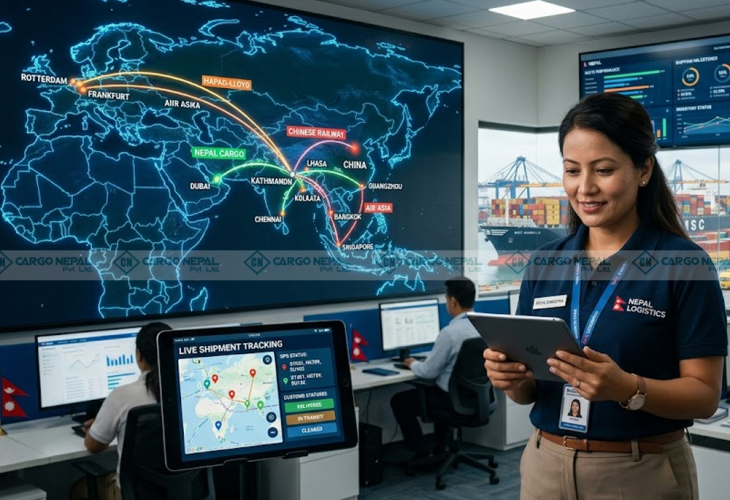
One of the biggest advantages of supply chain visibility is real-time shipment tracking.
In the past, businesses often had to wait for phone calls, emails, or manual updates to know where their cargo was located. Today, digital logistics platforms allow customers and freight forwarders to track shipments throughout the journey.
Real-time tracking enables businesses to:
Research shows that real-time tracking improves logistics efficiency and helps organizations react more quickly to disruptions.
For importers and exporters in Nepal, this means greater confidence when shipping goods internationally.
Reducing Delays and Operational Disruptions
Delays can occur for many reasons:
Without visibility, businesses often discover problems after they have already affected delivery schedules.
With modern supply chain visibility systems, logistics teams can identify issues early and take corrective action before delays escalate. Real-time alerts and predictive monitoring help organizations respond proactively rather than reactively.
This capability is particularly important in international cargo operations where multiple stakeholders are involved.
Improving Customer Satisfaction
Customers today expect transparency.
Whether they are large corporations or small businesses, clients want to know:
Providing regular shipment updates builds trust and strengthens business relationships.
Many logistics professionals now consider visibility to be one of the most important factors influencing customer experience because it reduces uncertainty and improves communication. (Beacon)
For freight forwarding companies, transparent communication can become a major competitive advantage.
Better Inventory and Supply Chain Planning
Visibility allows businesses to make informed inventory decisions.
When companies know exactly when shipments will arrive, they can:
Supply chain visibility helps businesses align procurement, production, transportation, and sales activities more effectively. Accurate information enables better forecasting and operational planning.
This is especially valuable for manufacturers, retailers, and distributors that depend on reliable supply chains.
Enhanced Risk Management
International cargo transportation involves various risks, including theft, damage, customs delays, route disruptions, and documentation issues.
Supply chain visibility helps businesses identify risks earlier and respond faster.
Industry research highlights that visibility improves resilience by enabling organizations to monitor supply chain performance and quickly address emerging problems.
Instead of waiting for a shipment to become overdue, logistics teams can detect warning signs and take preventive measures.
The Growing Role of Technology
Technology is transforming supply chain visibility in 2026.
Several innovations are helping logistics companies improve transparency:
GPS and Real-Time Tracking
GPS technology allows businesses to monitor cargo movement throughout the transportation process.
Artificial Intelligence (AI)
AI helps analyze large volumes of logistics data, identify patterns, predict delays, and optimize transportation routes. Industry analysts expect AI to play an increasingly important role in supply chain decision-making.
RFID and Smart Tracking Systems
RFID technology provides automated cargo tracking and improves shipment accuracy. Major logistics companies are investing heavily in RFID-based tracking solutions to enhance visibility and reduce errors.
Data Analytics
Advanced analytics enables businesses to identify bottlenecks, improve operational efficiency, and optimize logistics performance.
Challenges in Achieving Full Visibility
While visibility has improved significantly, challenges still exist.
Industry discussions frequently highlight visibility gaps during:
Many logistics professionals report that shipment information can become fragmented when cargo moves between different carriers or transportation modes. (Reddit)
As a result, freight forwarders continue investing in integrated technology platforms and stronger communication systems.
How Cargo Nepal Supports Supply Chain Visibility
At Cargo Nepal Pvt. Ltd., supply chain visibility is an important part of delivering reliable freight forwarding services.
Through professional shipment coordination, regular communication, cargo tracking support, and end-to-end logistics management, Cargo Nepal helps importers and exporters stay informed throughout the transportation process.
Whether handling air freight, ocean freight, project cargo, customs clearance, or inland transportation, the goal is to provide customers with greater transparency and confidence in their supply chain operations.
As international trade continues to grow, businesses increasingly need logistics partners who can provide not only transportation services but also accurate information and proactive support.
Conclusion
Supply chain visibility has become a cornerstone of modern cargo and freight forwarding. In an environment where delays, disruptions, and changing market conditions can affect business performance, access to real-time information is essential.
Companies that invest in visibility gain better control over their shipments, improve customer satisfaction, reduce operational risks, and make smarter business decisions. As technology continues to evolve, supply chain visibility will play an even greater role in shaping the future of international logistics.
For businesses involved in global trade, choosing a freight forwarding partner that values transparency and communication can make a significant difference. In 2026 and beyond, visibility is not simply about knowing where cargo is. It is about creating a smarter, more resilient, and more efficient supply chain.