- Home
- Blogs
- About
- Services
- Group Companies
- Contact Us
- सुचना *

-
Call Us On:
+977 1 5320150, 5320160 -
Send us a Mail:
info@cargonepal.com.np -
How Artificial Intelligence Is Transforming International Cargo Shipping in 2026
Introduction
The logistics and cargo industry has always been the backbone of global trade. Every day, millions of tons of goods move between countries through air freight, ocean freight, rail networks, and road transportation systems. As international trade continues to expand, logistics companies face increasing pressure to deliver shipments faster, more accurately, and at lower costs.
In 2026, Artificial Intelligence (AI) has emerged as one of the most important technologies driving this transformation. What was once considered futuristic technology is now becoming an essential part of everyday logistics operations. From route planning and warehouse management to cargo tracking and customer service, AI is helping logistics providers operate more efficiently than ever before.
For a developing trade hub like Nepal, these technological advancements create significant opportunities. As import and export activities continue to grow, businesses require smarter logistics solutions that can handle increasing shipment volumes while maintaining reliability and transparency.
At Cargo Nepal Pvt. Ltd., we understand that the future of logistics lies in innovation. By embracing modern technologies and continuously improving operational efficiency, we help businesses navigate the complexities of international shipping while ensuring smooth cargo movement across global markets.
Understanding Artificial Intelligence in Logistics
Artificial Intelligence refers to computer systems capable of performing tasks that traditionally require human intelligence. These systems can learn from data, identify patterns, make predictions, and automate decision-making processes.
Within the logistics industry, AI helps companies process enormous amounts of information in real time. Shipping schedules, weather forecasts, customs regulations, traffic conditions, warehouse inventory, and customer demands can all be analyzed simultaneously to support smarter decisions.
Instead of reacting to problems after they occur, logistics providers can now predict challenges in advance and take proactive measures to avoid disruptions.
This shift from reactive logistics to predictive logistics is one of the most significant developments shaping the industry today.
Why AI Matters More Than Ever in 2026
Global supply chains have become increasingly complex over the past decade. Businesses now source materials from multiple countries, manufacture products in different regions, and distribute them worldwide.
At the same time, customer expectations have changed dramatically.
Modern customers expect:
Meeting these expectations using traditional logistics methods can be challenging.
Artificial Intelligence helps bridge this gap by improving operational efficiency, reducing errors, and enabling faster decision-making across the entire supply chain.
As a result, logistics companies that successfully integrate AI into their operations are better positioned to serve customers and remain competitive in an increasingly demanding market.
Smarter Route Optimization and Transportation Planning
Transportation represents one of the largest costs in the logistics industry.
Selecting the right route can significantly impact delivery times, fuel consumption, and overall operational expenses.
Traditional route planning often relied heavily on manual calculations and historical experience. AI systems now analyze multiple variables simultaneously, including:
By evaluating these factors in real time, AI can recommend the most efficient transportation routes for cargo shipments.
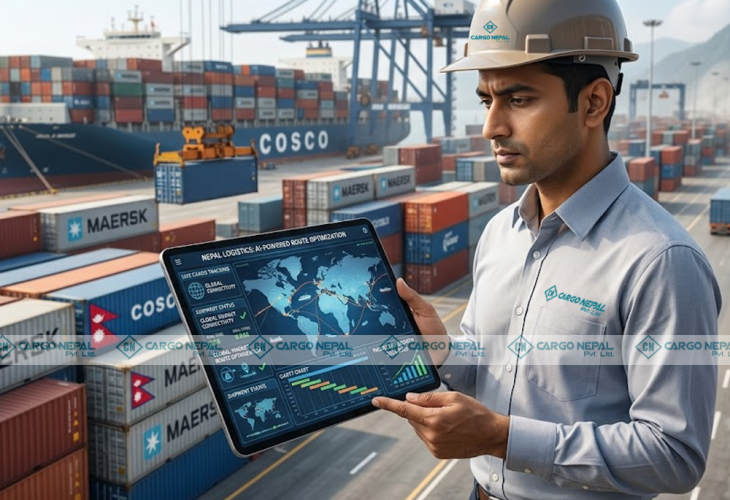
For Cargo Nepal Pvt. Ltd., smarter route planning means greater reliability for customers shipping goods internationally. Whether cargo is moving by air, sea, or land, optimized transportation planning helps reduce delays and improve overall service quality.
Real-Time Shipment Tracking and Supply Chain Visibility
One of the most noticeable improvements brought by AI is enhanced shipment visibility.
In the past, customers often had limited information about the status of their cargo once it left its point of origin. Updates could be delayed, incomplete, or difficult to obtain.
Today, AI-powered tracking systems provide near real-time visibility throughout the shipping process.
Customers can monitor:
This level of transparency improves customer confidence and enables businesses to better manage their inventory and delivery schedules.
For importers and exporters, having accurate information at every stage of the shipment journey is invaluable.
Predictive Analytics and Risk Management
One of the most powerful capabilities of Artificial Intelligence is predictive analytics.
By analyzing historical shipping data alongside current market conditions, AI systems can identify potential risks before they become serious problems.
Predictive analytics can forecast:
This allows logistics providers to make adjustments before disruptions occur.
Rather than waiting for problems to impact shipments, companies can proactively reroute cargo, secure alternative transportation options, or communicate expected delays to customers in advance.
This proactive approach reduces uncertainty and improves overall supply chain resilience.
Automated Documentation and Customs Clearance
International shipping requires extensive documentation.
Depending on the shipment type and destination, cargo may require:
Errors in documentation can result in costly delays and compliance issues.
AI-powered systems help automate document verification, identify inconsistencies, and ensure accuracy before submission.
This significantly reduces administrative workloads while improving compliance with international trade regulations.
For businesses importing or exporting goods through Nepal, streamlined documentation processes can help accelerate customs clearance and improve shipment efficiency.
AI-Powered Warehouse Management
Warehouses play a critical role in modern supply chains.
As cargo volumes increase, warehouse operations become more complex.
AI helps improve warehouse efficiency through:
Smart warehouse systems can determine the most efficient storage locations, monitor inventory levels automatically, and predict future stock requirements.
These capabilities reduce operational costs while improving order fulfillment speed and accuracy.
Enhanced Customer Service Through AI
Customer service remains one of the most important aspects of logistics.
AI-powered customer support systems are helping logistics providers respond faster and more effectively to customer inquiries.
Modern systems can provide:
This allows customers to access information quickly without waiting for manual responses.
At the same time, logistics professionals can focus on handling more complex customer needs that require human expertise.
AI and the Growth of E-Commerce Logistics
The rapid growth of e-commerce continues to transform global shipping patterns.
More businesses in Nepal are now selling products internationally through online marketplaces and direct-to-consumer channels.
This growth creates new logistics challenges including:
AI helps logistics providers manage these challenges by improving forecasting, inventory planning, and transportation coordination.
As Nepal's e-commerce sector continues to expand, AI will become increasingly important in supporting efficient international logistics operations.
Sustainability and Environmental Benefits
Sustainability is becoming a major priority throughout the logistics industry.
AI contributes to environmental goals by helping companies:
These improvements not only lower operating costs but also reduce the environmental impact of cargo transportation.
As businesses worldwide place greater emphasis on sustainability, AI-driven logistics solutions will continue to support greener supply chains.
Challenges of AI Adoption
While AI offers significant benefits, implementation is not without challenges.
Some common barriers include:
However, technology costs continue to decline, making AI solutions more accessible to logistics providers of all sizes.
As adoption increases, many of these challenges are becoming easier to overcome.
The Future of Cargo Shipping in Nepal
Nepal's logistics sector is entering an exciting period of transformation.
As infrastructure improves and international trade grows, technology will play an increasingly important role in supporting efficient cargo movement.
Future developments may include:
Businesses that embrace these innovations early will gain a competitive advantage in both domestic and international markets.
Conclusion
Artificial Intelligence is no longer a future concept. It is already transforming the way cargo moves around the world. By improving route planning, enhancing shipment visibility, automating documentation, optimizing warehouse operations, and supporting better customer service, AI is making international logistics more efficient than ever before.
As Nepal continues to strengthen its position in global trade, the adoption of advanced logistics technologies will become increasingly important.
Cargo Nepal Pvt. Ltd. remains committed to providing reliable, efficient, and innovative logistics solutions for businesses across Nepal and beyond. Through our expertise in air freight, ocean freight, customs brokerage, project cargo handling, inland transportation, and international logistics services, we continue to help customers navigate the evolving world of global trade with confidence.
The future of logistics is smarter, faster, and more connected. Cargo Nepal Pvt. Ltd. is proud to be part of that future.